Unlocking Creativity with Vintage Textile Junk Journal Printable Collections
There is a specific kind of magic that happens when you hold a piece of history in your hands, or at least, a high-quality representation of it. For many creatives, the allure of Vintage Textile Junk Journal Printable files lies not just in the aesthetic of faded florals and worn damasks, but in the immediate access they provide to a world of texture and story without the wait time of hunting through antique stores. These digital assets have become a cornerstone for artists, crafters, and small business owners who need reliable, high-resolution imagery to bring their visions to life.
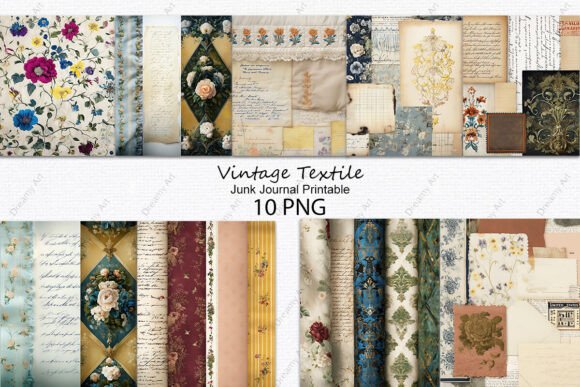
When we talk about these printables, we aren't just discussing low-res clips saved from a browser. We are talking about professional-grade resources, often delivered as a set of 10 PNG files, each rendered at a crisp 300 DPI and sized at 4500×5400 pixels. This level of detail matters immensely when you are moving from a screen to a physical object. Whether you are creating a intimate journal page or a large-scale sublimation project, the clarity of the source material dictates the quality of the final product.
Beyond the Journal: Real-World Applications for Digital Textiles
While the term "junk journal" is in the name, limiting these files to paper crafts would be a disservice to their versatility. The high resolution and transparent background capabilities of PNG formats open doors across various industries and hobbyist sectors. Consider the booming market of personalized home goods. A creator can take a vintage floral pattern from one of these sheets and apply it directly to a ceramic mug or a throw pillow using sublimation printing. Because the images are 4500×5400 pixels, they can be scaled up significantly without losing sharpness or becoming pixelated, ensuring the final product looks professional rather than homemade.
Fashion enthusiasts and DIY clothing designers also find immense value here. Imagine wanting a unique t-shirt that doesn't look like mass-produced merchandise. By selecting a specific vintage textile motif—perhaps a faded botanical or an intricate geometric weave—you can print it onto transfer paper or use it for direct-to-garment printing. The result is a wearable piece of art that carries the nostalgic weight of historical fabric designs. Similarly, tote bags and canvas sneakers serve as excellent canvases for these graphics, allowing individuals to curate their own aesthetic identity.
The stationery industry, too, relies heavily on such resources. Independent card makers often struggle to find unique papers that don't cost a fortune to ship or buy in bulk. With a Vintage Textile Junk Journal Printable pack, a crafter can print multiple copies of a single design on different textured cardstocks. One sheet might become a wedding invitation suite, while another becomes a set of thank-you notes. The ability to control the paper type—choosing a heavy cotton stock for a luxury feel or a recycled matte for an earthy vibe—gives the creator total control over the tactile experience of their product.
Who Benefits Most from High-Resolution Digital Collage?
Different users approach these files with different goals, and understanding these perspectives helps in maximizing their potential.
- The Memory Keeper: For scrapbookers, these images are time machines. They allow for the creation of themed albums where the background textures mimic the era of the photographs being preserved. A page dedicated to a grandmother's garden feels more authentic when backed by a dreamy art style floral textile that looks like it was torn from an old dress.
- The Small Business Owner: Entrepreneurs selling on platforms like Etsy or at local craft fairs need consistency and speed. Downloading a pack of 10 cohesive images means they can produce a entire product line—stickers, bookmarks, and framed art—that shares a unified visual language. This branding consistency is crucial for building a recognizable shop identity.
- The Mixed Media Artist: Artists who work with paint, ink, and glue often use these printables as underlayers. They might print a vintage wallpaper design, glue it down, and then paint over it, letting parts of the pattern peek through. This technique adds depth and complexity to artwork that is difficult to achieve with paint alone.
- The Educator and Therapist: In art therapy or classroom settings, having pre-made, beautiful elements allows participants to focus on expression rather than the pressure of creating something from scratch. Providing students with junk journal collage elements can lower the barrier to entry for creative projects.
Practical Considerations Before You Print
While the possibilities are endless, there are practical steps to ensure you get the most out of your Vintage Textile Junk Journal Printable files. First and foremost is the choice of printer and paper. Since these files are 300 DPI, they are optimized for high-quality output. Using a standard home inkjet printer on cheap copy paper will not do justice to the intricate details of the vintage fabrics. Investing in acid-free cardstock or specialized sublimation blanks is essential for longevity and color vibrancy.
Color management is another critical factor. Screens emit light, while paper reflects it. What looks like a soft, muted sage green on your monitor might print slightly darker or cooler depending on your printer's ink profile. It is always wise to run a test print on a small section of your chosen material before committing to a full batch, especially if you are producing items for sale. This ensures that the floral junk journal aesthetics translate accurately to the physical realm.
Licensing is also a key consideration. Most creators offering these files intend for them to be used in personal and sometimes commercial projects, but it is vital to read the specific terms included with your download. Some artists allow unlimited sales of physical items made with their prints, while others may have restrictions on selling the digital files themselves or using them in print-on-demand services where you do not handle the physical production. Respecting these boundaries supports the ecosystem of digital artists who spend hours curating and restoring these vintage gems.
The Emotional Resonance of Vintage Aesthetics
Why do we keep coming back to these old patterns? There is a psychological comfort in vintage textile designs. They evoke a sense of continuity, reminding us of craftsmanship and styles that have endured over decades. When you incorporate a decorative journal element featuring a 19th-century weave into a modern project, you are bridging a gap between the past and the present. This resonance is particularly powerful in gifts; a handmade card featuring a vintage fabric scan feels more thoughtful and curated than a store-bought greeting card.
Furthermore, the "imperfect" nature of these scans—the slight fading, the texture of the original weave, the subtle discoloration—adds character. In a world of sterile, vector-perfect graphics, these organic imperfections make the final creation feel human and touched by time. Whether you are making a digital journal on a tablet or a physical collage, these textures provide a grounding element that pure color blocks cannot achieve.
Ultimately, a collection of Vintage Textile Junk Journal Printable files is more than just a folder of images; it is a toolkit for storytelling. It empowers you to decorate your environment, create meaningful gifts, and build a small business with professional-grade assets. From the precise dimensions of 4500×5400 pixels to the versatile PNG format, every technical specification is designed to remove barriers between your imagination and the finished object. As you explore the 10 images in your set, consider how each one can transform a plain surface into a narrative piece, whether it ends up on a wall, a shirt, or a cherished page in a journal.